Carlo Perelli tells the story of Alfonso Morini (1898-1969),
"The man and the machine"
(best resolution: 1024 x 768)
1964
From: Motor Cyclist Illustrated, February 1964
The founder and boss of the Morini factory in Bologna, "il commendatore", (the boss) Alfonso Morini, is - like
Giuseppe Gilera - a self-made man who has come up the hard way ....
|
Apprenticed to the local smithy, he saved everything he could
towards the day when he would be able to open his own little workshop for repairing bicycles and motorcycles. That ambition
was achieved shortly before the outbreak of the first world war. Although already a motorcycle enthusiast, Morini was in no
position to buy one of his own and had to rely upon borrowed machines for his first exciting tastes of speed. But his workshop
had gained a sufficiently good reputation, by the time he was called into the army, for him to be able to get a posting to the
car and motor cycle repair section at Padua. This gave him an opportunity to improve his knowledge and skill and by the end of
the war, when he could return to his workshop in Bologna, Alfonso was ready to advance beyond the mere repairing of machines.
He found a partner in a Signor Mezzetti, another enthusiastic and skilled technician, and pooling their financial resources,
the pair were ready to go into production with their first MM (Morini-Mezzetti) machine by 1924. That first model was a 125cc
two-stroke - almost a moped, for those days - with two-speed hand-operated gearbox; and to give it an effective launching,
Morini began competing in as many as possible of the innumerable races being staged in Italy at that time. Successes soon came
his way, among them one on the tough Lario circuit (known as the "Italian T.T."), others in several important and less
important meetings up and down the country, and even several hill climb victories. Other famous riders, among them Landi and Tigli,
soon joined forces with Morini, and they had a barn-storming round of wins throughout Italy.
But the victory which remains as the proudest memory of Comm. Alfonso Morini is his own first really big success, when he won his
class in the 1927 Italian Grand Prix. Towards the end of the Roaring Twenties, with the MM factory by then having gained quite a
considerable reputation, Morini eased up his own racing activities.
|
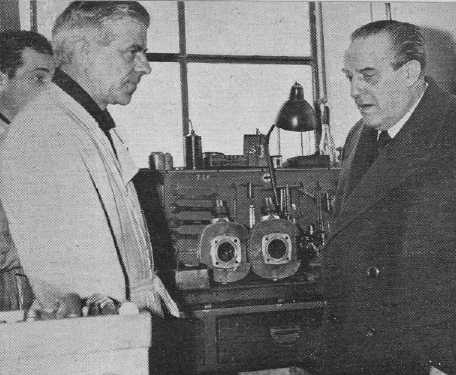 |
Ex-racers at the helm in Bologna. Dante Lambertini,
in white overalls, is visited in his racing department by factory chief Alfonso Morini (rhs).
|
 |
There were other
good riders to keep the MM name to the fore and he could afford to spend more time co-operating with Mezzetti on the technical
side. In the early thirties, they produced their first four-stroke racer. Of 175cc capacity it had a single overhead
camshaft, driven by a chain enclosed in a light alloy case on the right-hand side of the engine. This chain drive was to
continue as a feature of many other successful Morini racing engines, right up to the 1950s. From the outset, the 175 was a
success, among the most important of its many wins being Lama's victory in the 1933 Italian GP. It was also employed for
several record attempts with brilliant success - in that same year L. Bonazzi taking the flying kilometre world record at a
shade over 100 mph - without recourse to streamlining! A 250cc version was produced, and even a 350cc, and both were as
successful as the original. In 1938, for example, A. Mangione became Italian Senior Champion in the 350cc class, riding one
of the single-ohc MMs. By then the partners had split up. Morini, always something of an individualist, wanted to
 |
| Dick Renooy |
have a factory of his own. But those were difficult times for the Italian industry and, although he was
ready to go ahead with making motorcycles and had a new racing design on the board, he had to devote the factory to the making
of threewheeled trucks and, as soon as war broke out, to aero engine components. With the war over, Morini could at last devote
his partly wrecked factory exclusively to motorcycle production. He was one of the first Italian manufacturers to put a: new
model on the market, a sturdily constructed 125cc two-stroke with three-speed, in-unit gearbox and magneto ignition. A natural
step from this was the production of a racing model for the 125cc "tiddler" class which was beginning to figure in
international meetings. With basically the same engine, it had the advantage of a four-speed gearbox and was equipped with
plunger type rear suspension. Good use was made of this little machine by a promising newcomer named Umberto Masetti,
providing him with the experience which was later to see him twice winning the 500cc world championship for Gilera. Another
rider to have successes on these two-stroke Morini's was the young engineer Dante Lambertini, who was to become head of
Morini's racing department and the man behind the most remarkable single-cylinder 250 ever built. One of the first Italian
manufacturers to participate in racing outside Italy after the war, Morini had the 125cc class of the 1948 Dutch T.T. almost
in the bag when a cooked plug stopped Masetti's mount. Dick Renooy (Dutch) on an
Eysink-Villiers (it had a much-modified Villiers engine, with
rearward facing exhaust) went on to win. |
Cutting his racing teeth with an ohv 175cc Settebello model, young Agostini tackles the difficult San Remo
circuit - where there are
stone walls to stop you running out of road! |
The 125cc Morini's were faster than the rival MV's also two-strokes at that
stage - and in 1949 Masetti became the first Italian Senior champion for the 125cc class. But at the end of that season the
double-ohc Mondial 125 made its first appearance; and immediately it was clear that the two-strokes' days were numbered. So
Morini quickly entered the four-stroke field, with a 125 having a chain-driven single overhead camshaft, similar to the MM
of the 1930s. After more than a season of teething troubles, Morini's new star, Emilio Mendogni, pulled off a wonderful finale
to the 1952 season by winning his class in the Italian Grand Prix, following this with a repeat success in the Spanish Grand
Prix, held in October that year. And the next year he won the Italian Senior championship. In 1954 an enlarged version of the
125 was produced for Mendogni to win the 175cc class of the Italian Senior championship. The factory cashed in on this success
by giving more attention to production machine races, for which it introduced the excellent 175cc pushrod Settebello model. It
also gave support to the minor Italian meetings, in preference to the world championships, and to long-distance races like the
Milan-Taranto and the Tour of Italy. Alfonso Morini - who has never made much of a bid for export sales - considered that this
policy would provide him with better propaganda. Then, at the end of 1958, Morini burst back on to the international stage with
a sensational victory in the 250cc class of the Italian Grand Prix. |
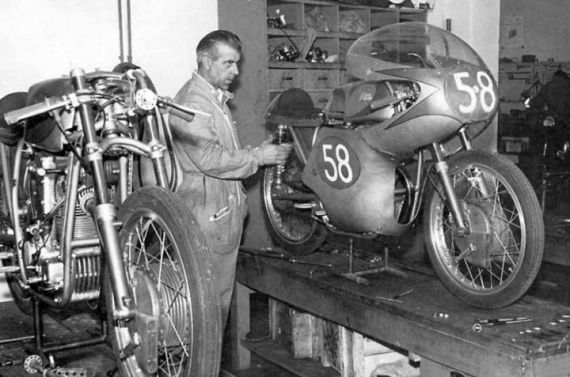
|
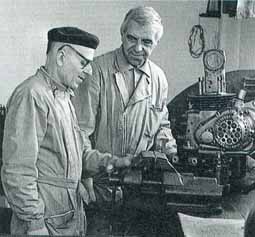 |
Dante Lambertini with his creation, the 250GP racer and on the right the 250GP engine on the bench.
Rhs picture: the man with the black hat is Nerio Biavati. |
 |
He had tried the experiment, the previous year, of running
an over-size version of the successful 175cc sports machine at Monza, but without very satisfactory results. Now a completely new
engine had been built - a complete breakaway from previous practice, in that it had gear-driven double-ohc valve gear. It produced
32 BHP and had a six-speed gearbox. Two of these machines were entered for the Grand Prix, with Mendogni and Zubani as riders.
Mendogni led all the way and won by a big margin while Zubani diced from start to finish with MV-mounted Ubbiali and, making
the fastest lap of the race, just beat him to the line. Provini, also on an MV, was already hopelessly out of the running
when he retired. The following year Derek Minter was teamed with Mendogni and Zubani for the Grand Prix events, but although
the factory had quite an active season in both international and national meetings, successes were few-largely because the
new twin-cylinder MV and the MZ twin two-stroke were producing more power.
Provini left the MV camp at the end of 1959 to become sole rider for Morini. His activities were confined mainly
to Italy the following season, where he had some tough scraps with Ubbiali, Hocking and the other MV riders. But development of the
Morini engine was continued with Provini himself making quite a valuable contribution - and in 1961 and 1962 Provini won the Italian
championship and enjoyed some successful appearances on foreign circuits. On the strength of this, it was decided to let
him make a bid for the 250cc |
First time out for the 250cc double-knocker came in 1958 when Emilio Mendogni romped
home winner of the Italian GP at Monza. |
world championship in 1963. "The fastest
single in the world" - as Comm. Morini likes to call it - was now producing 36 BHP. Its Japanese rivals exceeded this but the
Italian model scored with better handling and road holding. After a full season of racing, a certain amount of bad luck (cancellation
of the French GP, mechanical trouble in Holland and inability to obtain a visa for East Germany) and the fatal decision to give the
Isle of Man a miss, Tarquinio Provini still finished runner-up to 250cc world champion Jim Redman (Honda twin). And only two
points behind him! Now that Provini - who wants to end an outstanding career with a third world title to add to the two he
won as an MY team man - has switched to Benelli and Kreidler, Alfonso Morini is reverting once again to his old policy of
confining himself to the Italian meetings. But the temptation to try again for the world championship must still be there.
Can Morini resist it? He is a dyed-in-the-wool enthusiast and even if he sometimes seems a little embittered about
international racing - "it costs me 60 million lire a year, and yet it's completely ignored by the daily press" - he may
well have a change of heart, as the signing up of Silvio Grassetti already suggests! |
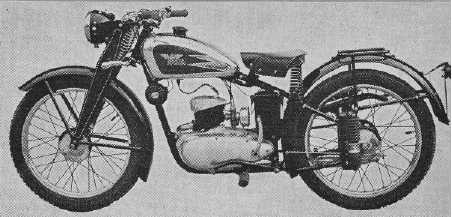 |
First post-war Morini was a 125cc two-stroke (above) which performed well in the ISDT, .... |
|

|
.... a racer (left) was soon developed from it, one of the fastest two-strokes of its time. |
Alfonso on an MM during a race in the 1920s. |
 |

|
(1954, left) When Mondial upset the two-stroke applecart with their 125cc double-knocker, Morini
retaliated with a single-cam job from which this 1954 175cc unit was developed. |
 |
First overhead-camshaft racer in
a long line associated with
Alfonso Morini was the AJS style
MM of 1932. Of 175cc capacity,
it had a British Albion gearbox. |
(1964, rhs) Due to be used for Italian rather than international events during 1964, the 250cc double-ohc
Morini is one of the most succesful single-cylinder units ever built. |
 |
|
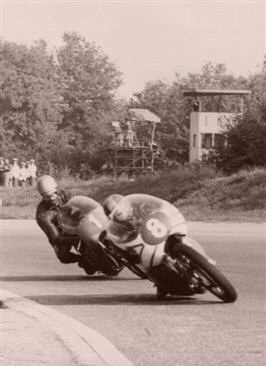
Tarquinio Provini (8) ahead of Jim Redman (1) at the Grand-Prix of Italy, 1963. |
| |

|
Although earlier overhead camshaft Morini's had chain drive to the valve gear, the current 250cc racer has
typically Italian gear drive (left). |
Back to index.
|

